The All Saints Bishop Falsely Claims Calvin Is Dead
Lessons in ChemistryThe All Saints Bishop Falsely Claims Calvin Is Dead is the moment a search for Calvin Evans becomes a deliberate deception. When Mr. Wilson arrives from the Parker Foundation intending to take a ten-year-old Calvin to living relatives who have only recently learned he exists, the Bishop of All Saints recognizes an opportunity for a donation and lies that the boy has died. He then elaborates the fiction, accepts money for a memorial fund, and leaves Calvin’s possible reunion with his family blocked by a story presented as fact.
Background and the Search
Before Mr. Wilson’s arrival, the bishop remembers Calvin as a boy repeatedly brought to his office for infractions: breaking a window, stealing a book, and giving a priest a black eye. Couples sometimes came to All Saints Boys Home hoping to adopt, but nobody had shown interest in Calvin. That history supplies the contrast on which the scene turns: a boy long passed over is now being actively sought by relatives, yet the bishop sees the visitor first as a potential source of institutional money.
Mr. Wilson identifies the child he wants as a ten-year-old boy, probably tall and with blondish hair. He explains that the boy lost his family through a series of accidents about four years earlier, and that living relatives have recently discovered his existence and want him back. He names Calvin Evans and makes clear that he intends to take the boy with him. His hurried manner—he has a flight in two hours—makes the purpose of his visit unusually plain: he is not negotiating an abstract charitable gift but trying to reach a particular child in time to bring him away.
The Bishop’s Deception
The bishop initially mistakes the visit for a chance to secure a large contribution. On hearing that a Parker Foundation representative is in the building, he imagines the donation he might obtain and plans to listen before pressing for more. Mr. Wilson’s actual request overturns that expectation. Rather than help him find Calvin, the bishop resents the visitor’s clothes and lack of an appointment, and stalls while looking at the gravestones of bishops who came before him. He knows the Parker Foundation’s promised funds are within reach and decides he cannot let them go.
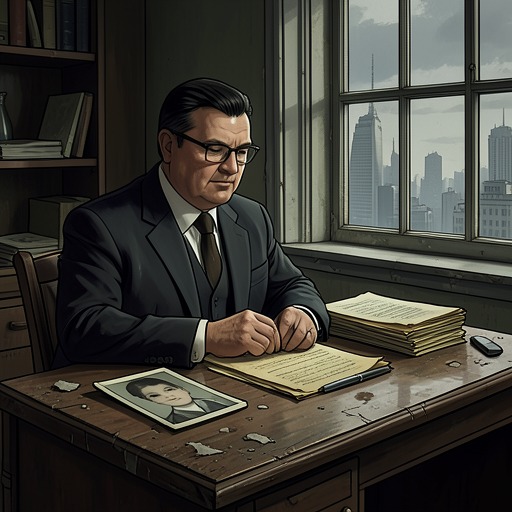
The lie is both blunt and calculated. The bishop tells Mr. Wilson that Calvin Evans is dead, then specifies that he supposedly died of pneumonia. When Mr. Wilson asks what he has just heard, the bishop does not withdraw the claim; he makes it more persuasive. He describes Calvin as a favorite at the home, with good manners, leadership in Bible class, and a love of corn. These invented particulars transform a bare falsehood into a memorial account, supplying the emotional texture that might make it harder for a grieving visitor to challenge.
The photograph deepens the performance. The bishop retrieves a black-and-white picture of Calvin and says it is being used for a memorial fund. Mr. Wilson looks at it in silence, apparently shocked and mournful. The bishop waits for him to demand proof, but the visitor’s grief instead gives the false story room to stand. Although the bishop briefly wonders whether Mr. Wilson might be a long-lost relative—perhaps even Calvin’s father—he allows that possibility to pass without correcting his claim.
The Memorial Fund and Its Consequences
Mr. Wilson eventually says the Parker Foundation will want to endow a memorial fund in Calvin’s honor. He gives the bishop a check on the Foundation’s behalf and says he will be in touch about structuring an ongoing contribution. The bishop accepts without looking at the amount until Mr. Wilson has left. Only then does he inspect the check and congratulate himself on the money, as well as the prospect of further contributions. The supposed memorial fund is not a response to Calvin’s death; it is the financial cover the bishop has created for a death that never occurred.
The scene does not show what becomes of Mr. Wilson’s search, but it establishes the immediate cost of the bishop’s words: a person seeking to take Calvin to his relatives is sent away believing the boy is dead. The lie’s practical force comes from the visitor’s trust in the institution and from the bishop’s authority to describe the child’s fate. The bishop turns that authority into an instrument of concealment, while the check rewards the very account that prevents the reunion.
Narrative and Significance
The episode is presented through the bishop’s recollection, so the reader sees how quickly he converts a humanitarian opportunity into a private calculation. His imagined acceptance speech gives way to disappointment when Mr. Wilson asks for a boy rather than offering money; the bishop then recasts the request as a chance to obtain funds through a fabricated memorial. The shift from anticipated donation to invented death gives the scene its sharp moral reversal.
The bishop’s closing self-satisfaction, in which he treats the check as evidence that God helps those who help themselves, exposes the gap between religious language and his conduct. He has not merely failed to assist a vulnerable child: he has invented a death, accepted charitable money on that basis, and used the appearance of mourning to keep the deception credible. The episode also lays groundwork for Reverend Wakely’s later effort to contact All Saints Boys Home again, now with the suspicion that the search for Calvin has not reached an honest end.